
The complete guide
How to Choose a Queen Silk Pillowcase, Momme, Grade and Fit Explained
The problem with waking up creased
Most people do not think about their pillowcase until something about it starts to annoy them. Hair that looks slept-on no matter what you did the night before. A cheek that carries the print of the weave for the first twenty minutes of the morning. A surface that feels warm and slightly rough by three in the morning. None of these are disasters. They are just small, daily irritations that come from sleeping on a fabric with a textured face.
Cotton is a short-staple fibre. However fine the weave, the surface is made of thousands of tiny fibre ends standing up from the cloth. Your face and hair spend seven or eight hours pressed against that. Silk is different in a basic structural way. The filament is long and continuous, so the woven face is flat. Less texture means less drag.
That is the whole argument for a silk pillowcase, and it is a simple one. It is not magic. It is a smoother surface.
What momme actually tells you
Silk is measured in momme, which is a weight unit. You will see numbers from about 16 up to 30 on pillowcases. Higher means denser and heavier cloth.
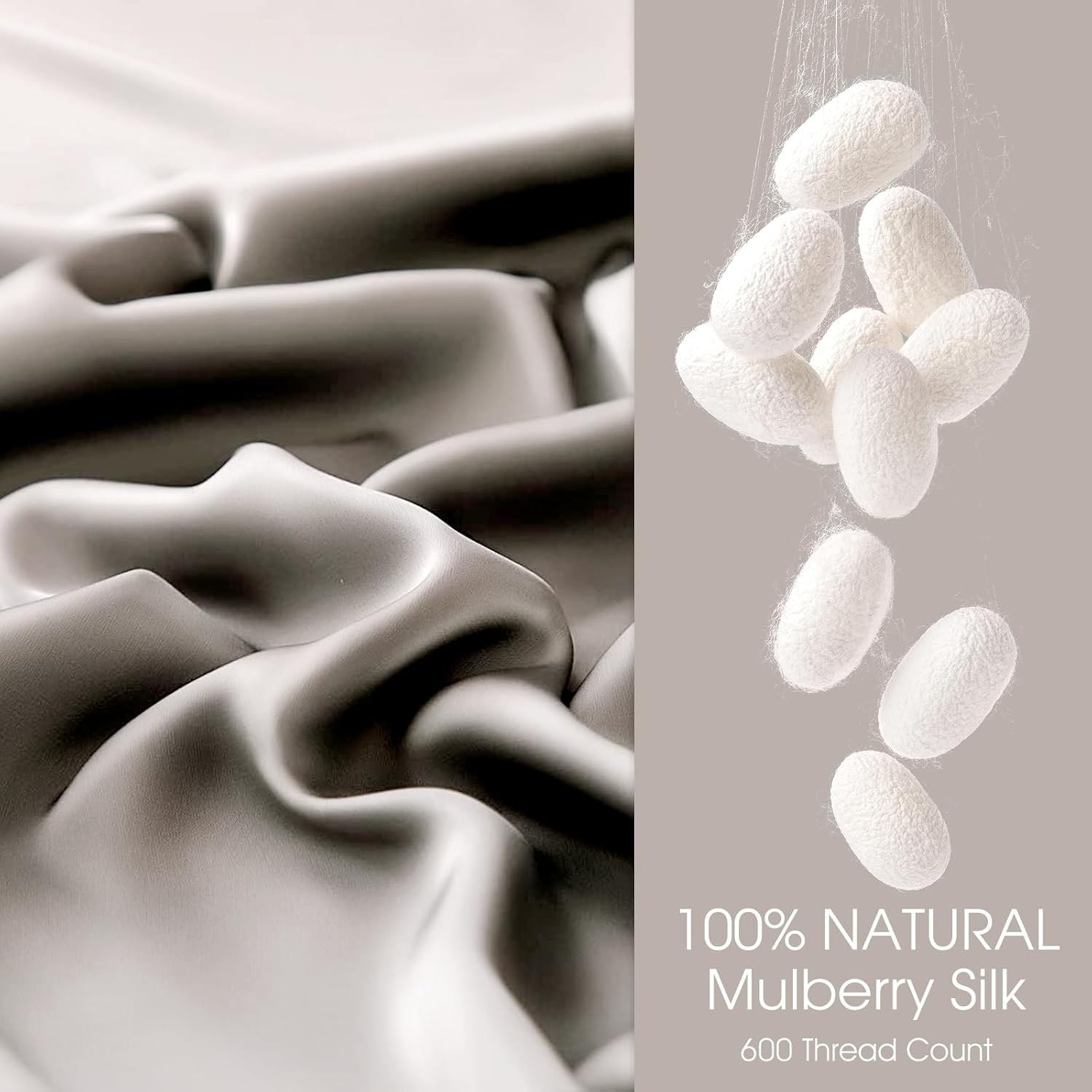
These cases are 19 momme. That sits right in the middle of the pillowcase range and it is there for a reason. Below about 16 momme, silk starts to feel thin and slippery, and it can be fragile in the wash. Above 22, the fabric gets heavier and begins to feel more like a furnishing cloth than bedding. Nineteen momme gives you a case that lies flat on the pillow, holds its shape at the corners, and still has that light, cool hand when you first touch it.
If you have read that 22 momme is "better", the honest answer is that it is heavier, not better. Some people prefer the extra substance. Plenty of others prefer a 19 momme silk pillowcase because it feels cooler and softer against the face. Neither choice is wrong.
The maker also lists a 600 thread count. With silk, thread count is less informative than momme, because the density of the cloth is already captured in the weight figure. Treat it as a supporting detail rather than the headline number.
Grade 6A, and why fibre length matters
Raw silk is sorted into grades based on how long and even the filaments are. The letter scale runs up to 6A, which describes the longest, most uniform fibres a mill separates out.
Why does that matter to you, lying in bed? Because long filaments can be spun into yarn with very few joins. Fewer joins means fewer small irregularities on the face of the finished weave. A Grade 6A silk pillowcase has a flatter, more even surface than one made from shorter, more mixed fibre, and that evenness is what you feel under your cheek.
It also affects how the fabric behaves over time. Yarn with fewer weak points tends to hold up better through repeated washing, assuming you wash it kindly.
Getting the size right
This is where most silk pillowcase purchases go wrong, and it is entirely avoidable.
Pillowcases in this category are cut to American sizes. There are three of them. Standard is 20 x 26 inches. Queen is 20 x 30 inches. King is 20 x 36 inches. These cases are queen, so 20 x 30 inches, which is 50 x 76 cm.
Pillow sizes are not standardised worldwide. A pillow sold as "standard" in one country may be a completely different length from one sold under the same name somewhere else. So ignore the name on your pillow's label and measure it instead. Lay it flat, press it down lightly, and measure corner to corner along the long edge.
If your pillow measures around 30 inches long, the queen silk pillowcase set of 2 fits well. If it measures closer to 26 inches, you will have a loose tail of fabric at one end. Some people genuinely do not care about that. Others find it bunches up and tugs. Know which kind of person you are before you order.
A small point on fill. A very plump, overstuffed pillow will fill a case more tightly than a flat one of the same length, which makes the silk sit taut. A flatter pillow leaves the case relaxed and the drape softer. Both are fine, it is just worth picturing.
The hidden zipper
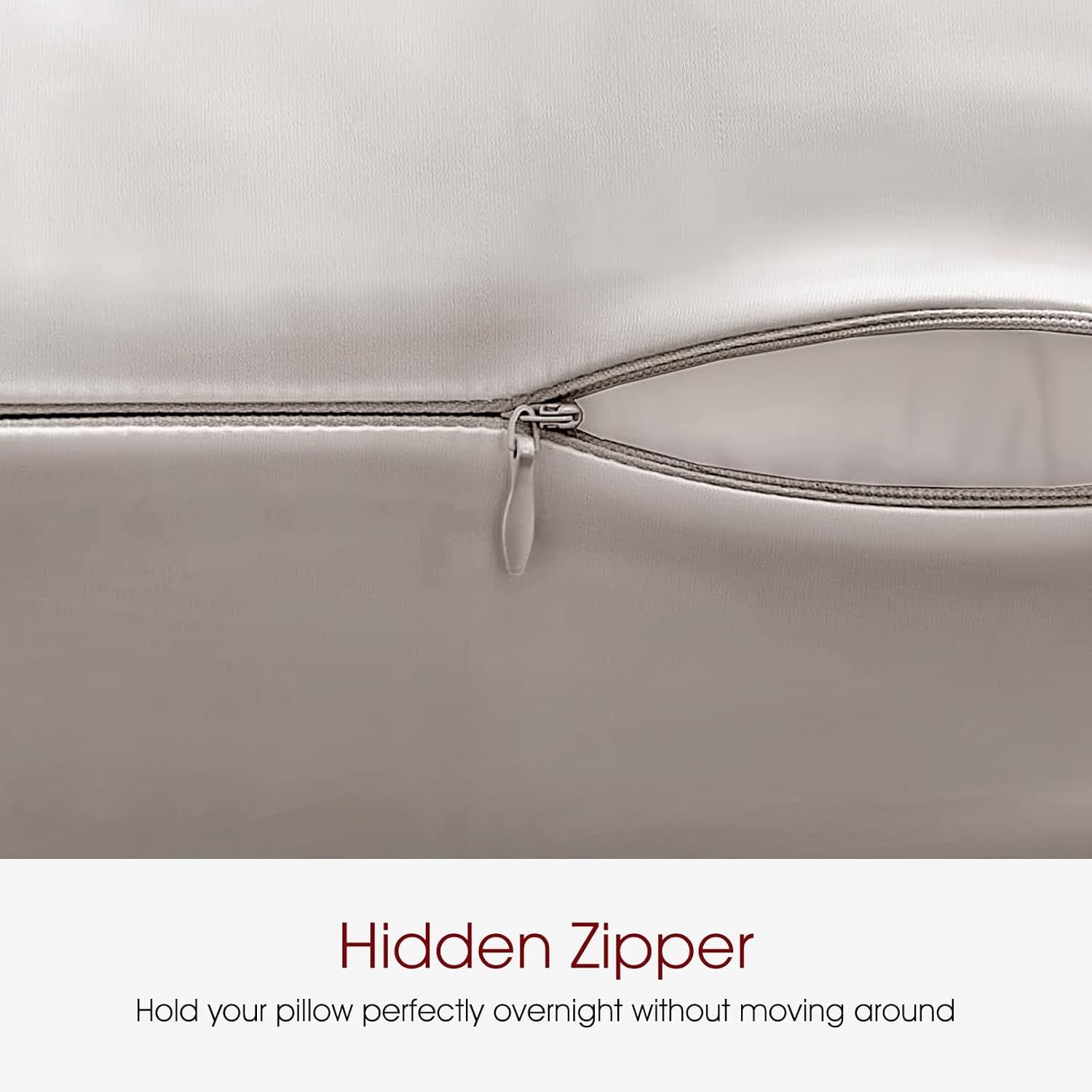
The closure on these is a zip sewn into the side seam, hidden under the fabric.
Compare that to an envelope closure, which is the flap-and-tuck arrangement you find on most cotton cases. Envelopes are cheaper to make and perfectly serviceable, but the pillow can work its way loose if you move around, and the overlapping flap creates a slight ridge on one side.
A zip closes the case completely. The pillow stays where you put it, and the sleeping face of the case stays uninterrupted. Hidden placement means the zip tape and pull sit tucked away rather than sitting proud of the seam.
One habit worth building. Zip and unzip slowly, with the silk held clear of the teeth. Silk is strong along its length but it does not like being caught in metal. Thirty seconds of care at each wash will keep the zip area looking as good as the rest.
Who this pair suits
Anyone with long or fine hair tends to notice the difference fastest, because long hair is the thing most obviously affected by friction. If you wake with your hair in knots at the back, a smoother surface genuinely helps.
People who sleep hot find silk pleasant because it does not hold warmth against the face the way a dense, heavy fabric does.
Anyone who presses their face hard into the pillow will appreciate a surface with less texture to it.
And anyone buying for a guest room or as a present will find a plain grey pair easy to place, since it works against white, charcoal and natural linen without any thought.
Why two is the right number
Buying a pair solves the thing that puts people off silk, which is the washing.
Silk should be hand washed, and hand washing takes a few minutes. With a single case, washing day means either going without or putting cotton back on the pillow. With two, you simply swap. One case is on the pillow, the other is drying or folded in the drawer, and the rhythm continues without effort.
There is a second reason. Solid colours can vary slightly between dye batches. A matched pair bought together comes from the same run, so both cases look identical on a bed made up with two pillows.
Washing silk without ruining it
The care instruction here is straightforward. Hand wash in cold or lukewarm water, then hang to dry.
In practice that means filling a basin, adding a small amount of mild detergent made for delicates or wool, and swirling the case through the water for a minute or two. No scrubbing, no twisting, no wringing. Rinse until the water runs clear. Press the water out between your palms or inside a clean towel, then hang the case up out of direct sunlight.
Silk dries quickly, so this is less of a chore than it sounds. It will usually be ready within a few hours.
Things to keep away from silk: bleach, enzyme detergents, optical brighteners, hot water, tumble dryers and strong direct sun. Each of these attacks the protein fibre or the dye. Keeping to the cold-and-gentle routine is what makes the difference between a case that lasts a few months and one that lasts years.
If a case does snag, do not cut the thread. Use a blunt needle to work the pull back through to the reverse side, and the weave will close over.
The short version
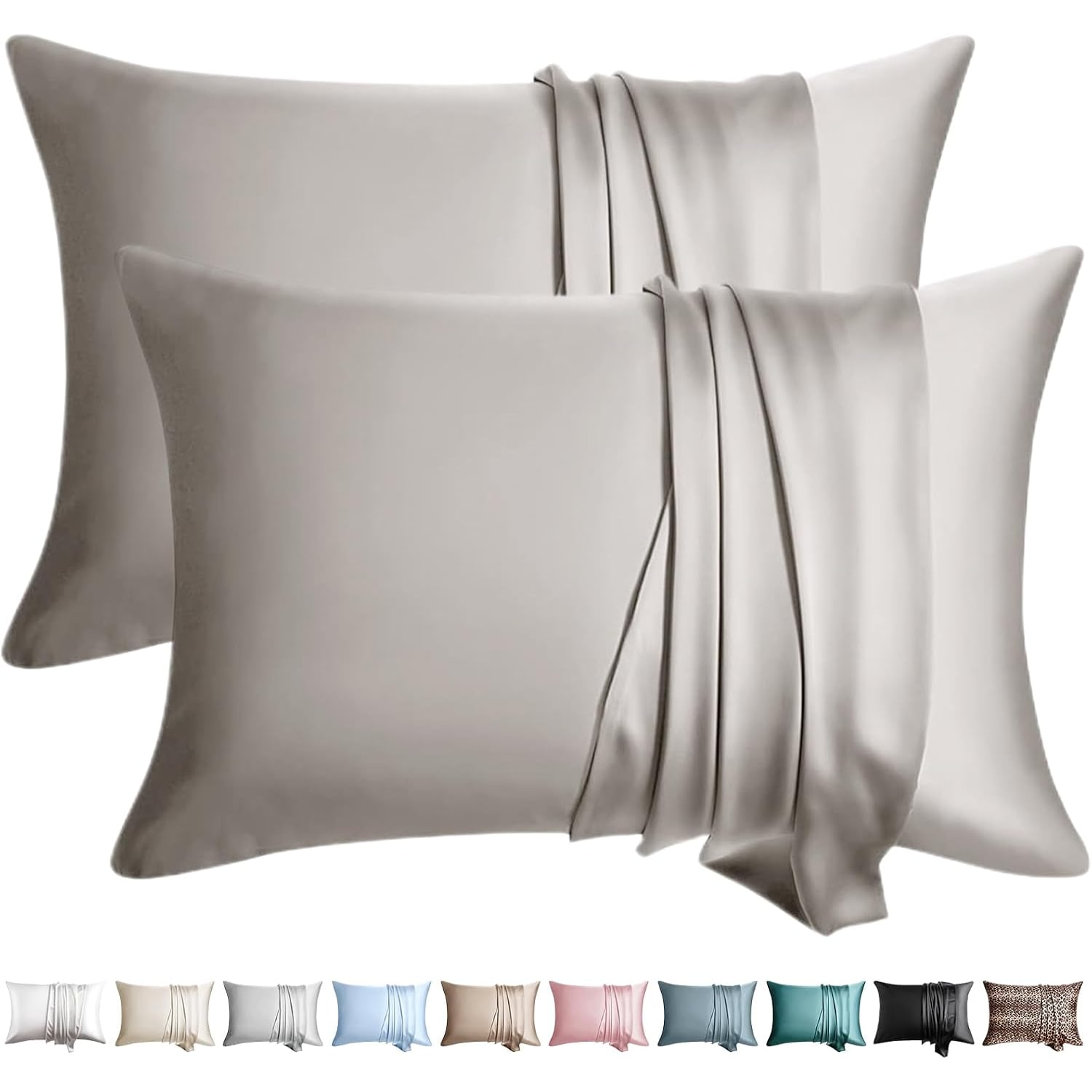
This is a matched pair of queen pillowcases in 100% mulberry silk, Grade 6A, woven at 19 momme, with a listed 600 thread count. Each one measures 20 x 30 inches (50 x 76 cm) and closes with a hidden zipper in the seam. The colour is a plain grey.
Measure your pillow before ordering, because the queen size is 30 inches long and pillows vary. Wash by hand in cool water and hang to dry. Do that, and a 19 momme silk pillowcase will keep its smooth face and even colour for a long time.