
The complete guide
Choosing Silk Pillowcases, A Practical Buyer's Guide
The problem with a cotton pillowcase
Most people never think about what their face spends eight hours pressed against. Cotton is fine. It is cheap, it washes well, and it has been the default for a century. But cotton is a grippy fabric at the surface. Roll over on a cotton pillowcase and your hair is dragged with you. Hair catches on the weave, skin creases where the fabric folds, and in the morning you have a flat patch on one side of your head and a line down your cheek that takes a while to settle.
Silk behaves differently because the fibre is smooth and the weave is dense. Hair slides over it instead of catching. That is not a health claim or a miracle, it is just friction, and anyone who has run a hand over both fabrics can feel the difference straight away.
That is the whole case for silk pillowcases, and it holds up. The question is which silk to buy, because the market is full of things that call themselves silk and are not, and full of real silk at weights and constructions that are not worth the money.
What momme actually tells you
Momme is the number that matters most, and it is the one shoppers understand least. It is a weight measure, borrowed from the traditional Japanese system, and it tells you how heavy a given area of silk is. Higher momme means denser fabric.
For bedding, the useful range runs from about 16 up to 25. Sixteen momme silk is light. It feels pleasant in the hand but it is thin, it creases more, and it wears out faster. Twenty two and twenty five momme are the premium weights, noticeably more substantial, and priced accordingly.
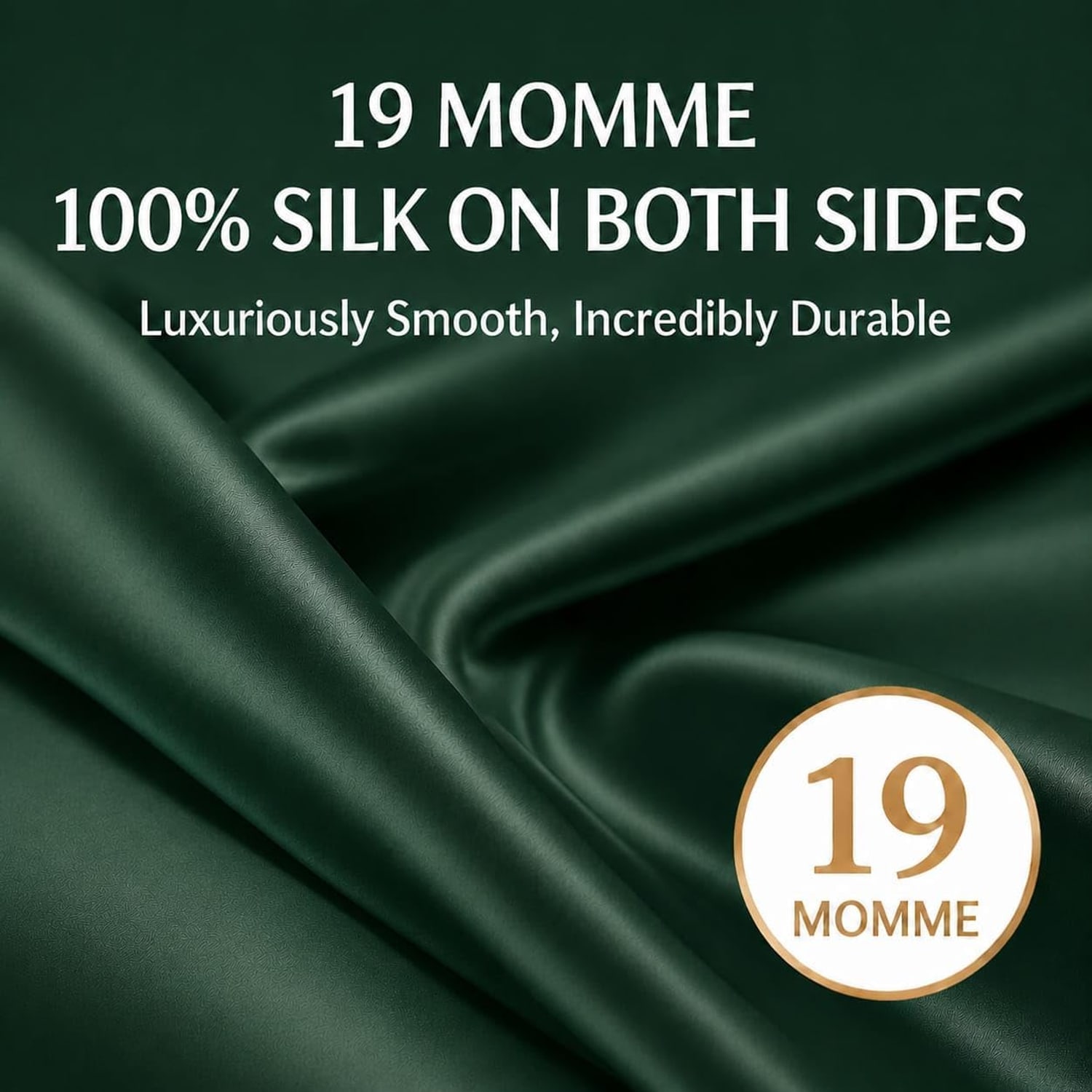
Nineteen momme, the weight of these pillowcases, is where most sensible buying lands. It has enough body to drape over a pillow properly instead of clinging to it, and enough weight to last through regular washing. It does not feel heavy against your face. If you are picking one number to shop by, 19 momme is the one that gives you a good fabric without paying for weight you will not notice.
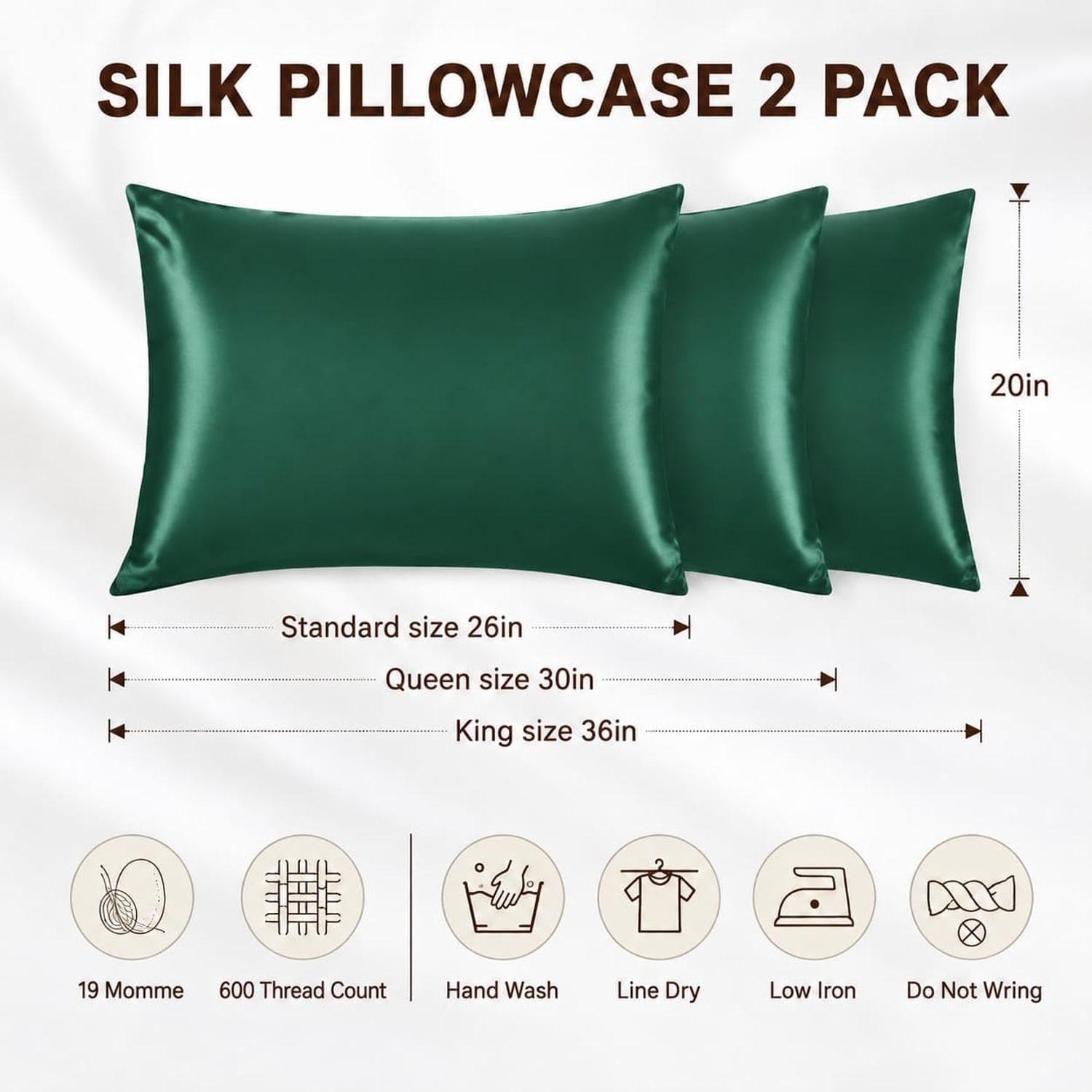
Thread count gets mentioned too. The maker lists 600 here. For silk, thread count is less informative than momme because of how silk yarns are counted, so treat it as supporting information rather than the headline number.
Silk on both sides, and why it matters
Here is the most common trick in budget silk bedding. A pillowcase is advertised as silk, and the face you see is indeed silk, but the back is cotton or polyester. The maker saves money, the listing is technically honest, and the buyer only finds out when they turn the pillow over at two in the morning and wonder why it suddenly feels like a different product.
These are silk on both sides. That gives you three practical benefits. You can flip the pillow without losing the smooth surface. You can put the case on either way round without thinking. And the fabric wears evenly rather than having a hard-wearing face and a soft one.
If you are comparing two listings and one is clearly cheaper, this is the first thing to check. The phrase to look for is both sides, or front and back. If a listing is vague about the backing, assume it is not silk.
The closure, which is less boring than it sounds
Pillowcases close in one of three ways: an open end, an envelope flap, or a zip.
An open end is the cheapest and the worst. The pillow works its way out overnight.
An envelope flap is a folded tail of fabric that tucks back over the pillow. It works, and it keeps the design simple, but the folded layer sits behind your head and can bunch up. On a silk case, a flap also adds a thickness change that you can sometimes feel.
A zip holds the pillow firmly and keeps the end of the case flat. The thing to look for is a hidden zip, where the zipper is set under the fabric rather than running exposed along the edge. These use a hidden zipper with a long opening. The long opening is a small practical detail that makes a real difference: you can slide a full pillow in without wrestling it, and changing the case takes seconds rather than becoming a two-handed struggle.
Getting the size right
Pillowcase sizing is a mess internationally, because pillows themselves vary by country. These are cut to American sizing, where standard is 20 x 26 inches (50 x 66 cm), queen is 20 x 30 inches, and king is 20 x 36 inches. The width is the same across all three. Only the length changes.
So the whole sizing question comes down to one measurement. Lay a tape along your pillow, seam to seam, and read the length. If it is 26 inches or a touch under, standard is your size. If it is closer to 30, you want a queen. If your pillow is a deep contoured foam shape, measure the height too, because a tall pillow eats into the fit even when the length is right.
A case that is slightly larger than the pillow is not a problem. It sits a little loose and is easier to take off. A case that is too small is a problem, because forcing a pillow in strains the seams and the zip.
Living with silk
Silk has a reputation for being delicate that is only half earned. It is not a fabric you can throw in a hot wash with towels, but the care routine is simple once you have done it twice.
Wash cool, either by hand or on a gentle machine cycle with the case inside a mesh bag. Use a detergent made for delicate fibres. Skip bleach entirely, because it attacks the fibre, and skip fabric softener, because silk does not need it and the residue dulls the surface.
Do not wring it. Press the water out between your hands or roll the case in a towel. Then line dry out of direct sunlight. Sun is the main enemy of any dyed fabric, and a dark green will hold its depth far better in the shade.
If you want it crisp, iron on the lowest setting, on the reverse, while slightly damp. Most of the time you will not bother, because silk dries fairly flat.
Having two cases makes all of this easier. One is on the bed, one is in the wash, and you never end up back on cotton for a night because the laundry did not get done.
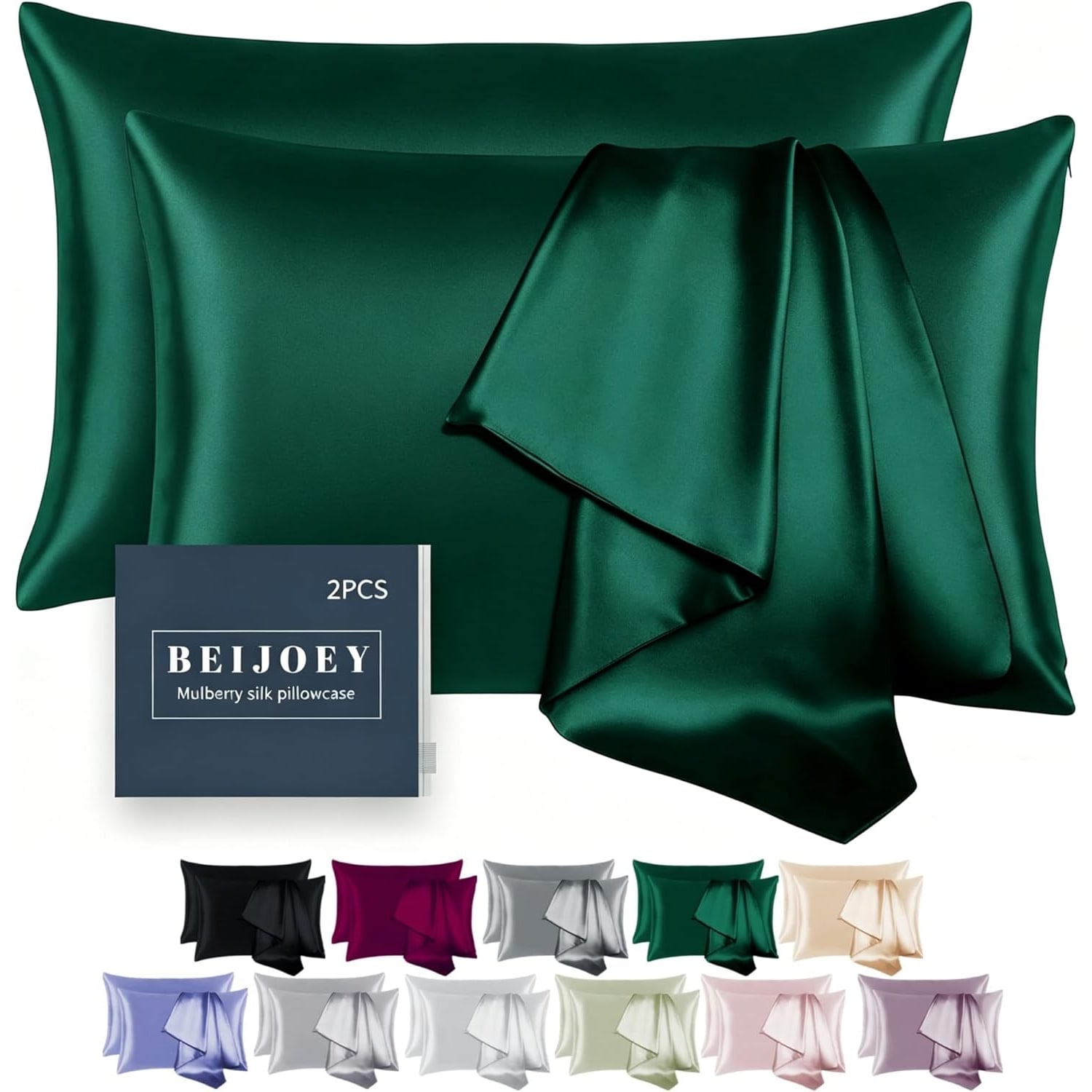
Why dark green
Colour is personal, but dark green earns its place for a couple of practical reasons alongside the look.
It is a deep solid shade that sits comfortably with timber frames, brass fittings, cream bedding and grey walls. It reads as considered rather than attention seeking, which suits a bedroom better than a bright colour does.
It is also forgiving. Pale silks show every water mark and crease line, especially right after a wash. Dark green does not. Lint and pale hairs are more visible against it, but a shake handles that.
The short version
Buy for weight, construction and fit, in that order. Nineteen momme is the practical sweet spot for silk bedding, heavy enough to drape and last, light enough to feel cool. Silk on both sides means the surface you paid for is the surface you actually sleep on. A hidden zip with a long opening keeps the pillow in and the fabric flat.
Measure your pillow before ordering, because American standard sizing is 20 x 26 inches (50 x 66 cm) and nothing else matters if the fit is wrong. Then wash cool, dry in the shade, and leave the bleach in the cupboard. Two cases in the pack means one is always ready, which is the small thing that turns a nice purchase into one you actually use every night.