
The complete guide
Buying Guide
The problem with sleeping on cotton
Most of us never think about what happens to our hair between lights out and the alarm. You lie down, you turn over four or five times, and each turn drags your hair across the pillow. Cotton feels soft to a fingertip, but under a microscope it is a rough, thirsty fibre. It grabs at hair, pulls strands out of place, and draws moisture out of the ends.
The result shows up in the morning. Frizz where there was none. A style that looked good at ten at night and looks tired at seven. Curls that have gone flat on one side. Braids that have fuzzed at the edges. None of it is dramatic, but it adds up across a week.
A silk bonnet solves this in the simplest possible way. It puts a smooth surface between your hair and everything your hair would otherwise rub against. Instead of catching, strands slide. Instead of sleeping on a towel, your hair is sleeping on something closer to glass.
Why mulberry silk specifically
Not all silk is the same. Mulberry silk comes from silkworms fed a single diet, which produces long, even filaments. Those long filaments weave into fabric with very few joins and a very smooth face. That smoothness is the whole reason the fabric works for hair.
Cheaper hair coverings get sold as "silky" or "satin", and satin is worth understanding. Satin is a weave, not a fibre. You can weave polyester in a satin pattern and it will look shiny, but it behaves differently against hair and holds heat in a way real silk does not. When a product says 100% mulberry silk, as this bonnet does, you know what you are getting.
This bonnet is black, solid, with no print or contrast trim. That is a practical choice more than a style one. Dark colours hide the inevitable traces of hair oil and product better than pale ones, and plain black does not fight with anything else you own.
Single layer or double layer
This is the main decision when you shop for a sleep cap, and it gets glossed over constantly.
A double-layer bonnet has two thicknesses of fabric, sometimes with the outer layer in a different material. It sits higher on the head, holds its shape when it is off, and feels substantial. Some people prefer that structure. The trade-off is bulk and warmth.
A single layer bonnet, like this one, is one thickness of mulberry silk. It is thinner on the head, lighter, and does not trap as much heat. It also follows the shape of your head rather than standing away from it, which many people find less noticeable while they sleep. If you have ever taken a bonnet off at two in the morning because your head felt hot, the single layer version is the one to try. It is also the easier of the two to pack for travel, because it flattens to almost nothing.
Coverage is identical. Both put a full layer of silk between hair and pillow. The difference is how it feels, not how it functions.
Getting the fit right
A bonnet that falls off is worse than no bonnet, because you wake up with half your hair on the pillow anyway and a cap somewhere in the sheets. Fit is what separates one you wear every night from one that lives in a drawer.
This one uses two mechanisms. The elastic edge gathers the opening and gives baseline grip. The tie lets you adjust beyond what the elastic does on its own. That combination matters. Elastic by itself stretches out over months and loses its hold, and it tends to press a mark into skin when it is tight enough to stay put. A tie by itself can work loose if you move a lot.
Start loose. Put the bonnet on with your hair arranged how you want it, then draw the tie in just until the bonnet feels secure when you shake your head gently. That is the right setting. If you find a line on your forehead in the morning, you have gone too tight by a notch.
Size, and why bigger is usually better
An undersized bonnet does two bad things. It squashes your hair flat against your scalp, undoing whatever shape you had, and it creeps upward through the night until it slides off entirely.
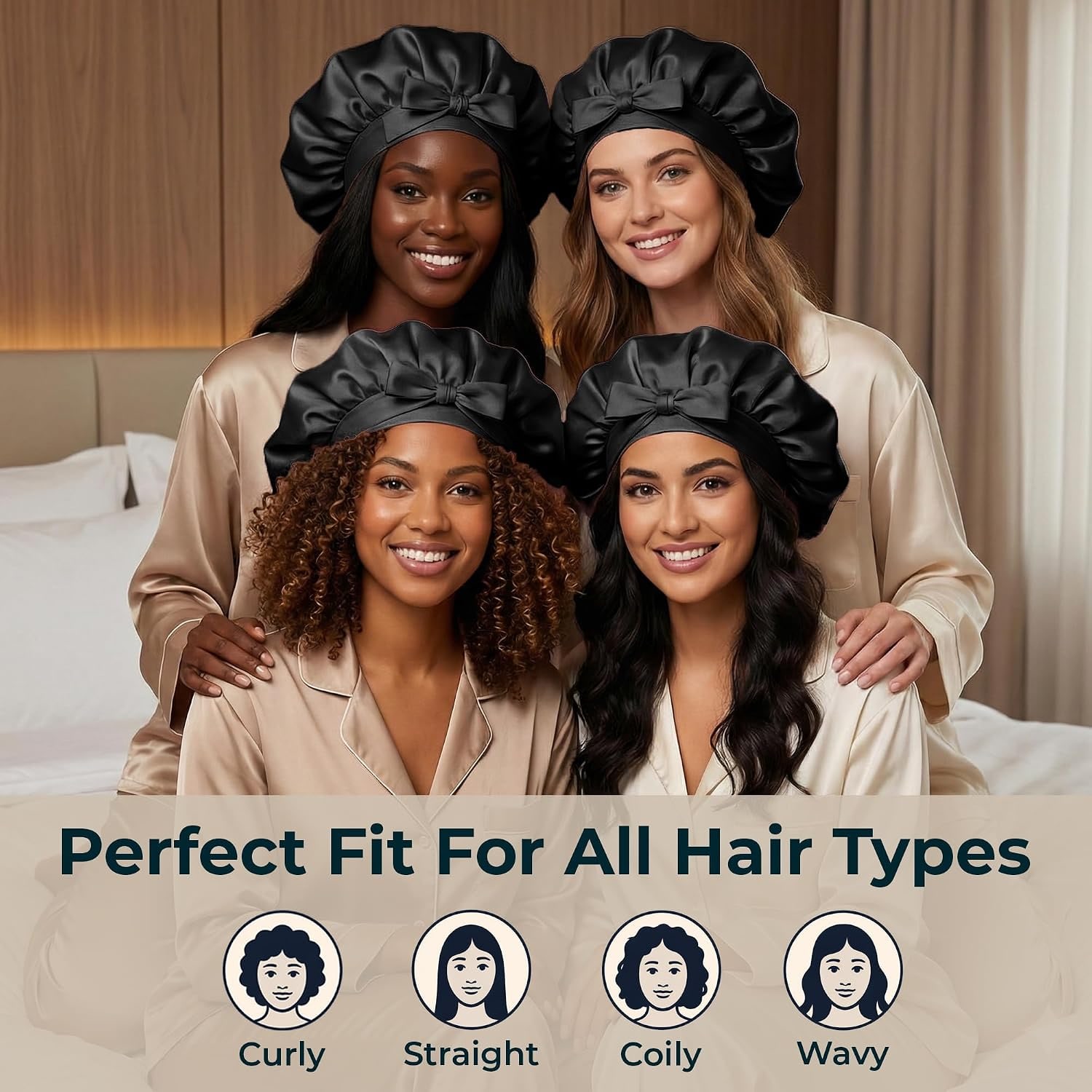
This bonnet is cut extra large with room for long or thick hair. That generous volume means you can leave length loose inside, coil it gently, or gather it high on your head first. Curls keep their spring because nothing is pressing down on them. Braids and twists sit inside without compressing at the root, which is where tension causes the most trouble.
If you are between options and not sure, size up. A bonnet with extra room still works on shorter hair, but a small one never works on long hair.
Daily use in practice
Dry your hair first, or nearly. A damp head inside a cap stays damp a long time and leaves the silk wet by morning.
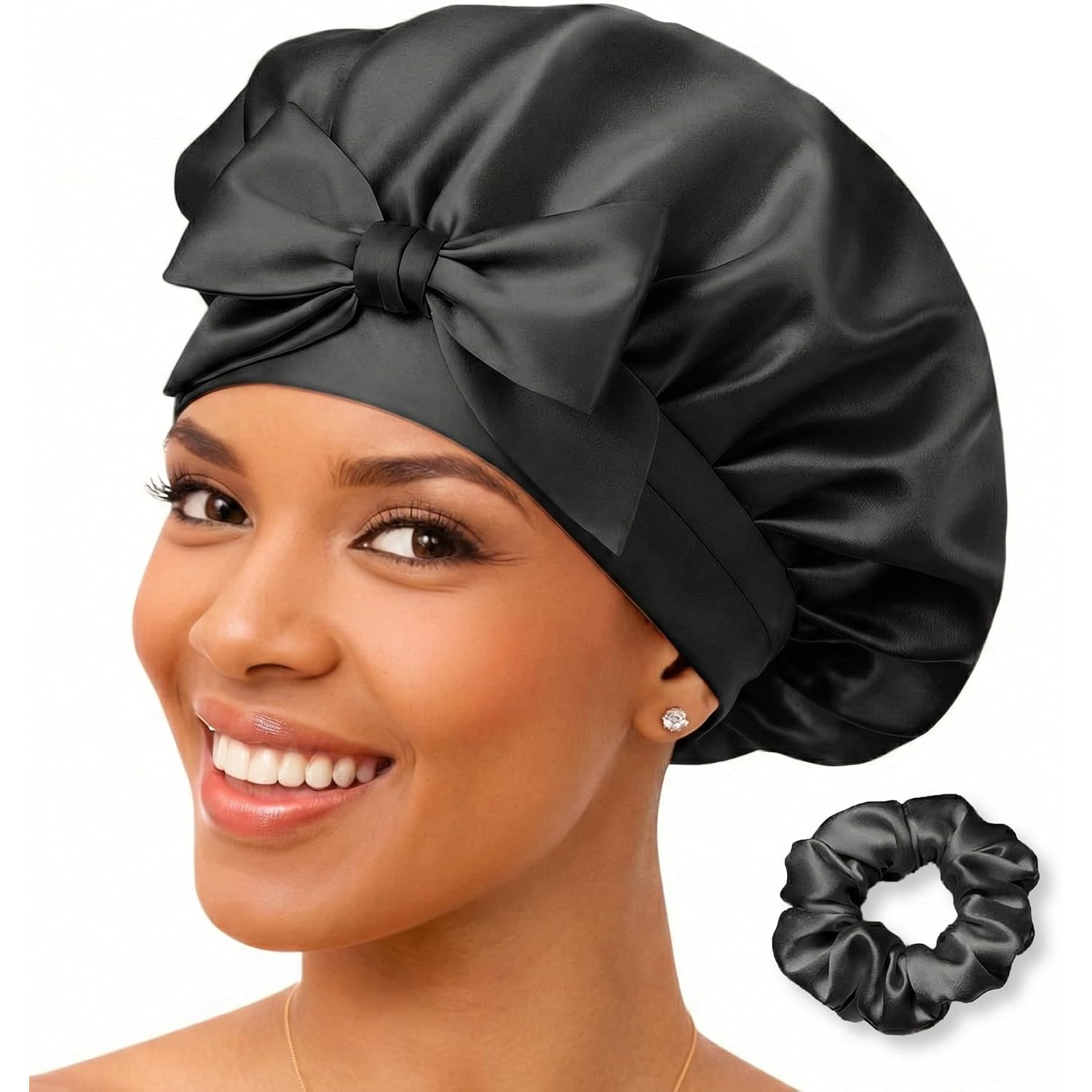
Gather your hair the way you normally would. Many people with curls pile everything loosely on top before putting the bonnet on, which keeps curl shape intact. Straighter hair can go loose or in a soft low coil. A fabric-covered scrunchie is the kinder way to tie it, and this bonnet comes with a matching one in the photos.
Put the bonnet on from the front and pull it back over the hairline, tucking in any loose ends at the nape. That back edge is where hair escapes most often. Then set the tie.
In the morning, take it off slowly rather than yanking it. Shake your hair out and reshape with your fingers.
Looking after it
Silk is a protein fibre, closer to hair than to cotton, and it wants similar treatment. Hand wash only, in cool water, with a mild detergent made for delicates. Swirl it rather than scrubbing. Rinse thoroughly, because leftover detergent is what makes silk feel stiff.
Never wring it out. Lay it flat in a clean towel, roll the towel up, and press. Then dry it flat or hang it in the shade, away from direct sun and heat.
No bleach, no tumble dryer, no hot iron. If it needs pressing, use the lowest setting with a cloth over the silk. Most creases fall out after one night of wear anyway.
Wash it every week or two, more often if you use heavy oils or leave-in products. Residue builds up on the inside of any bonnet and will eventually transfer back to clean hair.
Who this suits
Anyone with long hair that tangles overnight. Anyone with curls or coils trying to stretch a wash day further. Anyone with braids, twists or locs who wants less fuzz at the edges. Anyone who sleeps warm and has found padded bonnets too much. Anyone who travels and wants something that packs flat.
It is less obviously useful if you have very short hair that barely touches the pillow, though some people still use one out of habit.
The short version
This is a black bonnet in 100% mulberry silk, built as one thin layer rather than two, so it is lighter and cooler on the head than most. It is cut extra large with room for long or thick hair, and it fastens with both an elastic edge and a tie so you can set the fit yourself. A matching scrunchie is shown with it. Hand wash only, dry flat, and it will stay smooth for years. If you want a mulberry silk sleep cap you will actually keep wearing, lightness and a proper adjustable fit are the two things that decide it.