
The complete guide
How To Choose A Silk Bonnet That Actually Fits And Lasts
The problem with sleeping on cotton
Most people never think about what their hair does for eight hours a night. It moves. You turn over, you shift position, you bury your face in a pillow, and all of that movement drags hair across whatever fabric you happen to be lying on.
Cotton is a textured weave. Under a magnifier it looks like a field of small ridges. Hair catches on those ridges, which is why you sometimes wake up with the back of your head looking like a bird nested in it overnight. Silk is a different kind of surface. The fibre is smooth and sits flatter, so hair slides across it rather than snagging.
A silk bonnet is simply a way to get that smooth surface against your hair without having to re-sheet your entire bed. It travels, it works on any pillow, and it costs a fraction of a full silk bedding set. For a lot of people it is the easiest entry point into silk.
What 22 momme actually tells you
Silk gets sold on a lot of vague words. Momme is one of the few numbers that means something concrete.
Momme measures weight. It comes from the weight of a fixed length and width of fabric, and the higher the number the denser the silk. Thin silk sits around 16 momme. Heavy silk, the kind used in good bedding, runs 22 to 25. This bonnet is 22 momme, which puts it squarely in the substantial range.
Why does weight matter for a bonnet? Two reasons. Denser silk holds a shape, which means the bonnet sits over a mass of hair rather than collapsing flat against it. And denser silk takes washing better. Thin silk goes limp and starts to look tired after a few months of hand washing. A 22 momme weave has more to give.
If you are comparing the best mulberry silk bonnet options across a few shops, the momme number is the first thing to look at. If a listing does not state it, the silk is usually light.
The double-sided detail most people miss
Here is a trick that runs through a surprising number of silk bonnets on the market. The outside is silk. The inside, the part that actually touches your hair, is polyester or satin.
That makes commercial sense for the seller. Silk costs considerably more than polyester, and the outside is what shows in product photos. It makes very little sense for the buyer, because the whole benefit of silk comes from the surface against the hair.
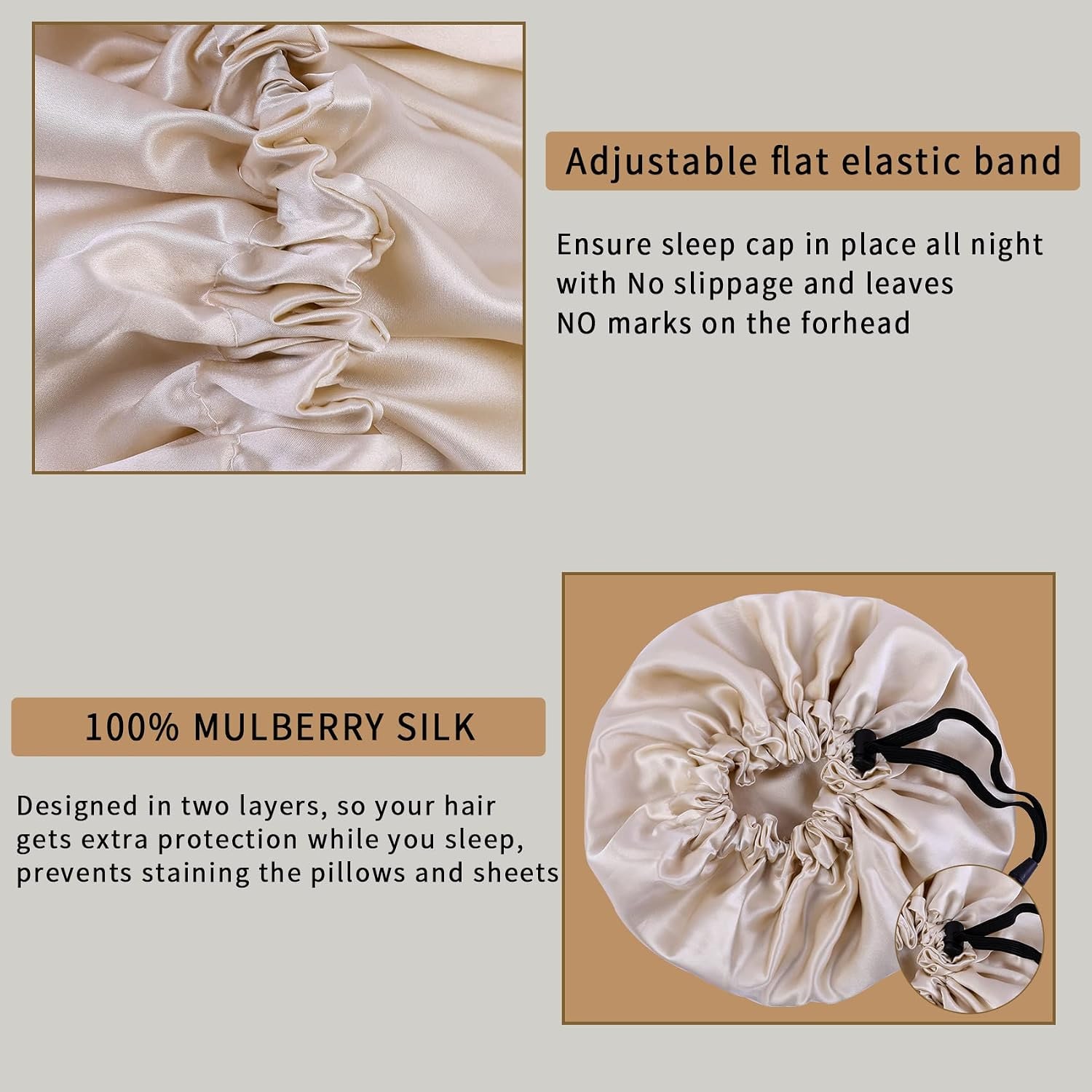
This bonnet uses 100% mulberry silk on both layers. Inside and out, it is the same fabric at the same 22 momme weight. That has a practical upside beyond just doing the job properly: you can wear it either way round. Turn it inside out and nothing changes in how it feels. The best double sided silk bonnet designs all work this way, and once you have used one, a single-sided cap feels like a compromise.
Mulberry silk, for what it is worth, refers to silk from silkworms raised on mulberry leaves. The fibres come out long and uniform, which is what produces the smooth, even surface silk is known for.
Getting the fit right
Fit is where most bonnet purchases go wrong, and it is usually one of two problems.
Too tight and it presses a line into your forehead that takes an hour to fade in the morning. Too loose and it slides off somewhere around three in the morning, which defeats the entire purpose.
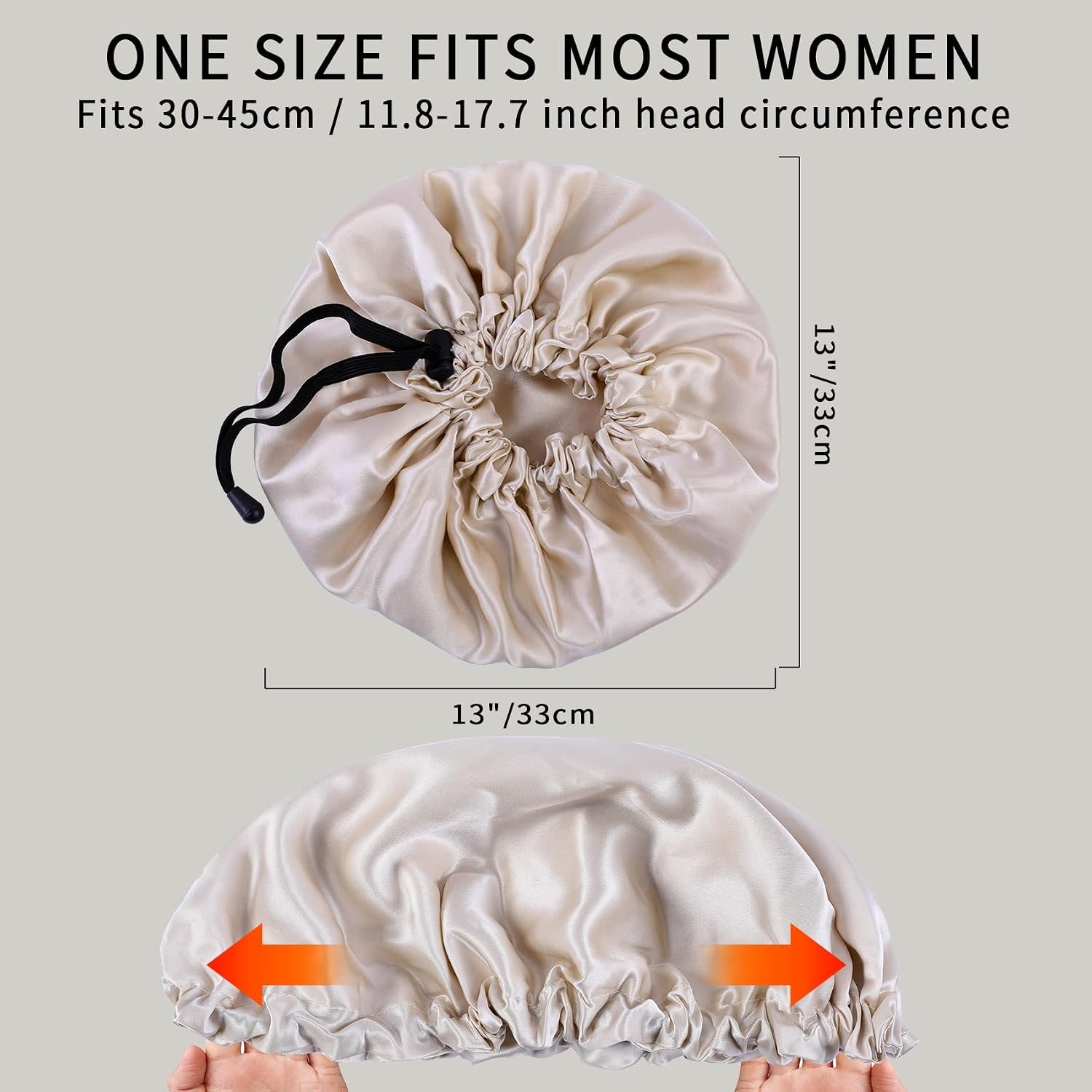
This bonnet handles both with an extra-wide band and adjusters built into the edge. The width matters. A thin elastic cord concentrates all its pressure along a narrow strip of skin. A wide band spreads the same hold across a larger area, so you feel it much less.
The adjusters let you dial in the opening. It will take a head circumference of up to 17.7 inches, which is about 45 cm. To check your own, run a tape measure around your head just above the ears and across the fullest part of the back. Most adults land between 21 and 23 inches of actual head circumference, but a bonnet opening works differently since the fabric stretches and the hair sits inside rather than the head filling the space. The practical test is simpler: if you can fit your hair in comfortably and the bonnet stays put when you shake your head, the fit is right.
Start loose and tighten gradually over a few nights. People almost always over-tighten on the first try.
Who this suits
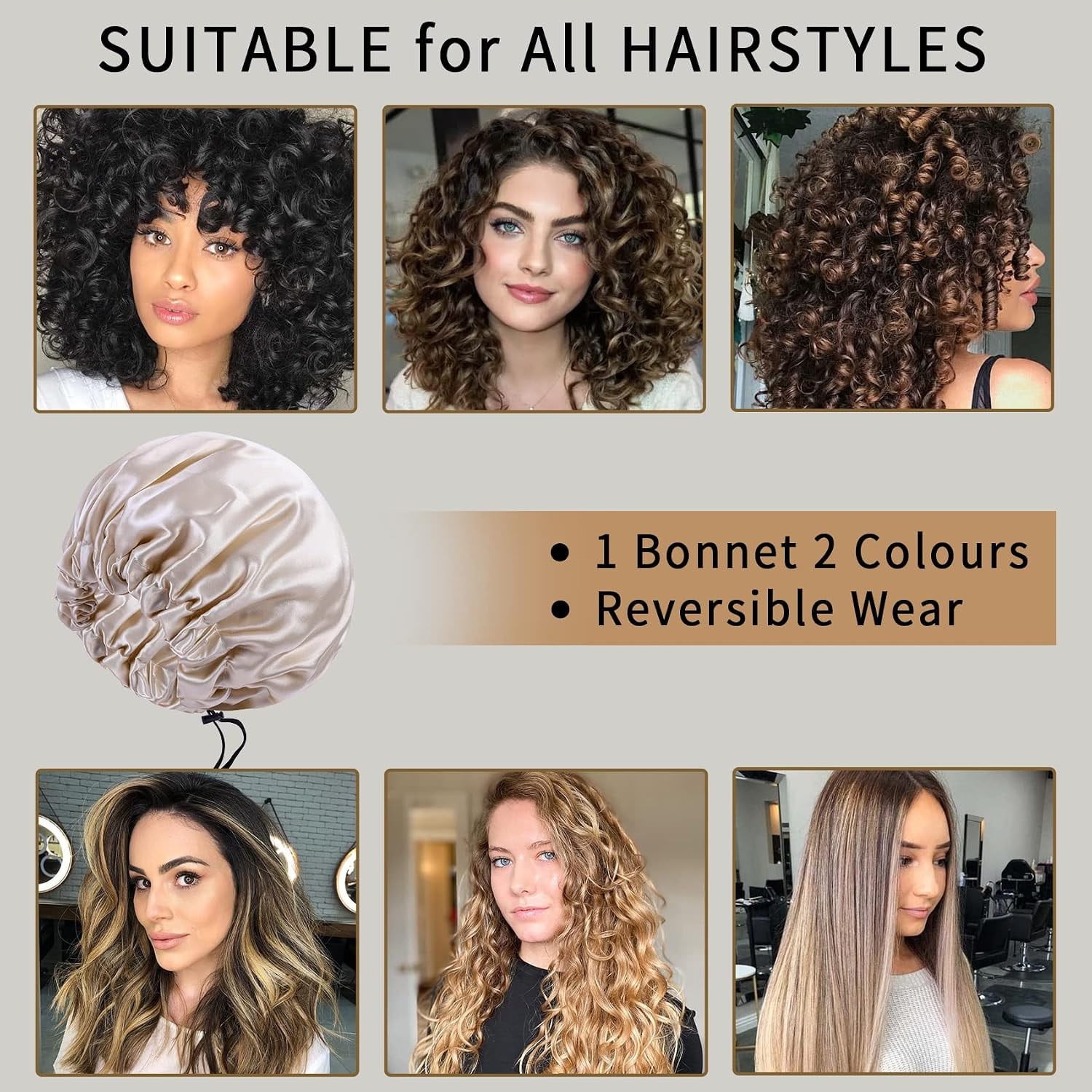
Curly and coily hair is the most obvious match. Curls lose definition when they get crushed and rubbed against a pillow, and a bonnet keeps the pattern contained. Pile curls loosely on top of the head, tuck them in, and the shape holds.
Long straight hair benefits for a different reason. Length means more surface area dragging across the sheet every time you move. Coiling it up and containing it cuts that down considerably. The best silk bonnet for long hair is simply one with enough room, and the 17.7 inch opening here gives you that.
Short hair works too, with the band set looser since there is less bulk pushing outward.
It is also worth saying that a bonnet is not only for sleeping. Keeping hair off the face while removing makeup, washing, bathing, or working through chores is a perfectly good reason to own one. Many people end up wearing it far more during the day than they expected.
Living with it
Silk needs a gentler hand than cotton, but the routine is not complicated.
Hand wash in cool water with a mild neutral detergent, the kind sold for delicates. Skip the bleach entirely. Squeeze the water out gently rather than wringing, since twisting stresses the fibres. Hang it to dry somewhere out of direct sunlight, which is both kinder to the fabric and kinder to the colour.
If it needs smoothing, iron on the lowest silk setting with a thin cloth between the iron and the fabric.
How often you wash depends on what goes under it. Clean, dry hair means every week or two is fine. Hair oils, leave-in treatments and masks all transfer into the silk, so if you use those regularly, wash more often. The scrunchie takes the same care.
One habit worth building: wash the bonnet and scrunchie together. They are the same fabric, they need the same treatment, and you will not lose the scrunchie in a drawer.
The short version
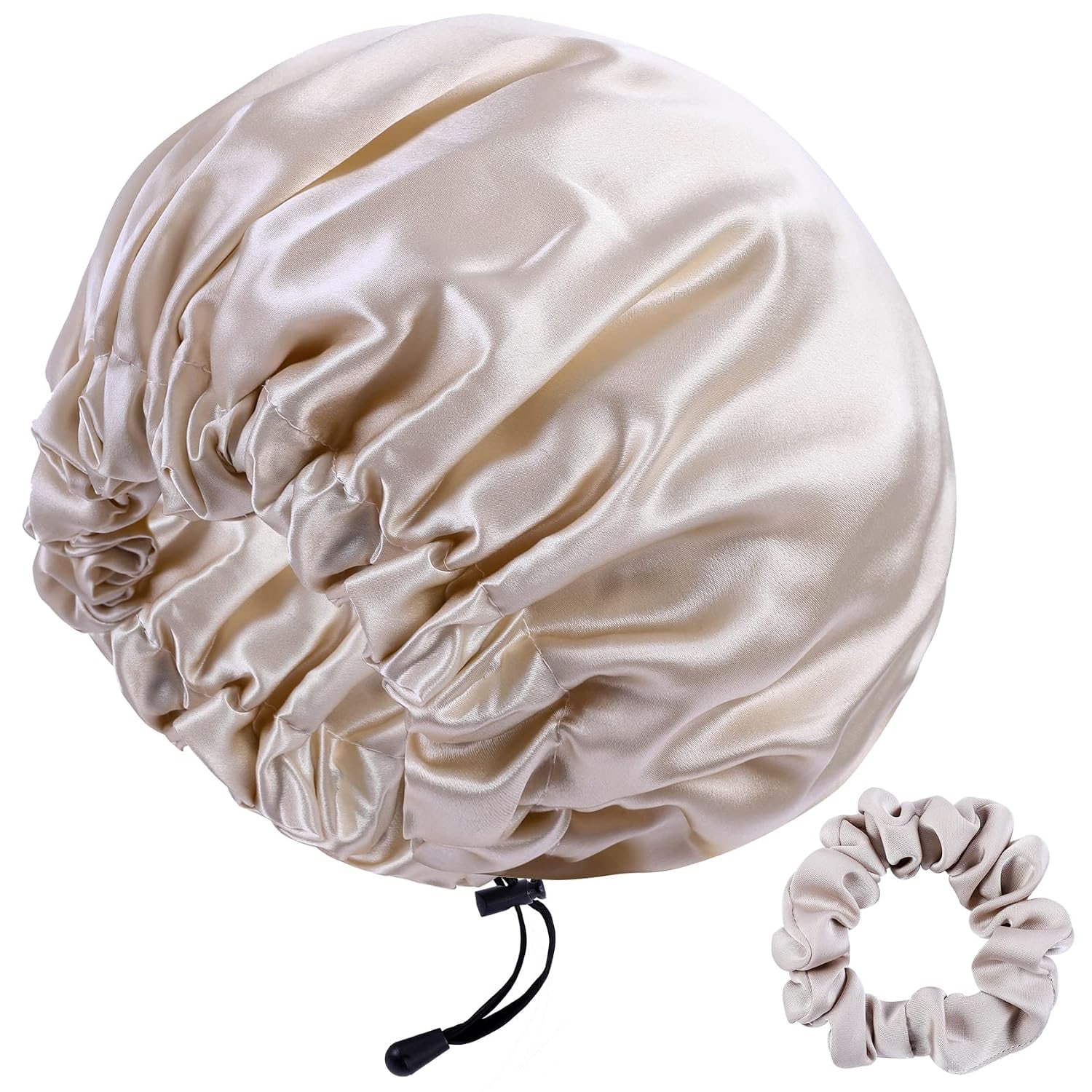
You are buying a reversible sleep cap made from 100% mulberry silk on both layers at 22 momme, with a wide adjustable band that fits a head circumference up to 17.7 inches, in a soft beige. A matching mulberry silk scrunchie comes with it.
The two details that separate it from cheaper caps are the silk on both sides, which means your hair only ever touches real silk, and the 22 momme weight, which gives it body and staying power through regular washing.
Measure your head, start with the band loose, hand wash it in cool water, and let it dry out of the sun. That is genuinely all there is to it.